Expanding MES from Pilot Line to Global Standard
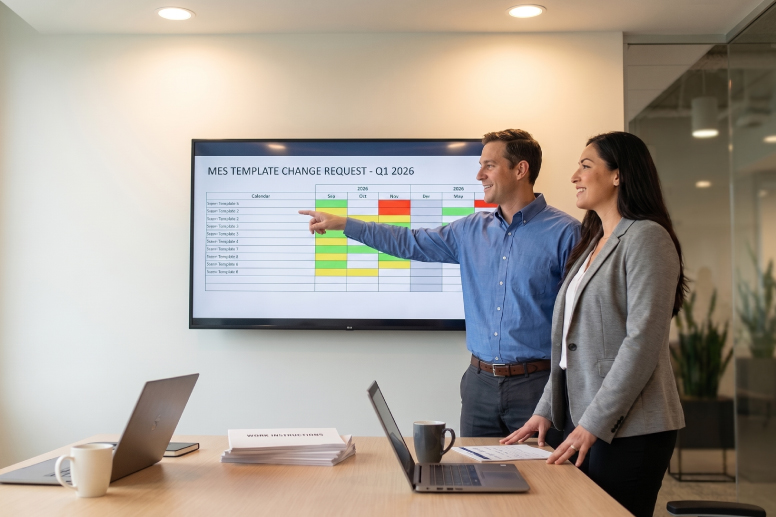
Scaling MES globally works best when you scale standards first.
Pilot lines can prove basic fit, but they rarely prove MES scalability across plants with different products, equipment, and compliance needs. Small defects in requirements, testing, and data definitions compound when you copy them to dozens of sites. A disciplined rollout matters because inadequate software testing was estimated to cost over $2 trillion each year as reported by the Consortium for Information & Software Quality (CISQ).
The sustained value comes from treating the system like a global operating standard, not a collection of local screens and workarounds. Organizations often see faster deployments, cleaner analytics, and fewer audit surprises when the template, data model, and release process are designed for reuse. Teams that skip that work often end up “re-piloting” at every plant, which burns budget and erodes confidence.
What global MES scale means after a successful pilot
Global scale means each new plant goes live with minimal redesign and predictable outcomes. The MES becomes a repeatable template for how work is released, executed, checked, and recorded. Sites could have differences, but those differences are controlled and traceable. A pilot proves a line can run; scale proves the operating model can hold.
You should expect the hardest problems to shift from screens to governance. The question stops being “can operators use it?” and becomes “can we keep sites aligned as products, routings, and regulations change?” If yield, cycle time, and defect codes cannot be compared across plants, you do not have a global standard (even if every site is “live”).”
Scale also changes what “done” looks like for IT and operations. Support shifts to release planning, regression testing, and steady data quality checks. That work feels slower at first, but it prevents the slowest outcome of all, which is a global MES rollout that gradually turns into a long tail of site-specific fixes.
Standardize workflows and the data model before adding plants
Standardization starts with defining the smallest set of workflows and data every plant must share. That usually includes controlled routing rules, genealogy, nonconformance, rework, labor capture, and electronic instructions. You then lock down a common vocabulary for units, operations, resources, and defect codes. Consistent definitions typically matter more than perfect detail.
Start with process outcomes that must be identical across sites, then document where variation is allowed. Regulated products often require the same traceability, signatures, and retention rules across plants, while packaging or local labeling can vary. The team should agree on what is mandatory, what is optional, and what is forbidden, then use that as the template contract.
Data model discipline is the hidden source of speed later. If part numbers, revisions, routings, and equipment identifiers follow consistent rules, onboarding a plant becomes a data load plus configuration, not a rebuild. If those basics differ by site, every integration and report will require special handling, and scaling manufacturing systems turns into constant reconciliation work.
Select an MES architecture built for multi-plant scalability
Architecture choices determine how much change you can absorb without breaking sites. A scale-ready MES supports centralized templates, controlled configuration, strong security boundaries, and reliable performance across regions. It also supports automated testing and repeatable deployments, so release cycles stay stable. If updates require heavy local rewiring, scale often slows or becomes unpredictable.
Cloud deployment is not the point by itself; operational patterns are. You want consistent identity management, uniform logging, predictable upgrade processes, and a clean separation between “global template” and “site configuration.” Teams using 42Q in multi-site rollouts often treat that separation as a hard rule so local needs do not drift into permanent forks.
| Scale checkpoint | What breaks when it is missing | What “scale-ready” looks like |
| Template and configuration separation stays strict | Plants drift into one-off variants that cannot accept updates | Global templates stay versioned, while sites only adjust parameters |
| Identity and access rules work across many sites | Audit findings rise as roles and approvals vary by location | Clean central roles map for local teams with least-privilege access |
| Upgrades can be tested and released on a schedule | Each release becomes a special project with emergency fixes | Release cadence includes regression tests and rollback plans |
| Data extraction stays consistent for analytics | KPIs cannot be compared because fields and codes diverge | Canonical events and codes feed reporting with stable meaning |
| Resilience supports outages and local continuity needs | Production stops when a single dependency fails | Clear offline and recovery behavior is defined and tested |
| Resilience supports outages and local continuity needs | Production stops when a single dependency fails | Clear offline and recovery behavior is defined and tested |
| Security monitoring and logging scale with site count | Incidents take longer to detect and investigate | Central logs support traceable actions across plants and shifts |
Design integrations and master data for repeatable plant deployments
Repeatable deployments require repeatable integrations and master data ownership. ERP, PLM, and quality systems must exchange the same objects in the same formats at every site. You should define which system owns each field; how updates flow, and how conflicts are resolved. Integration design is part of the global template, not a site task.
Master data needs rules that survive scale, including naming, revision control, effectivity dates, and location hierarchies. Interface contracts should specify events such as work order release, route revision, material issue, and completion confirmation. When a site requests an exception, treat it like a product change request with cost and risk attached, not a quick favor.
Interoperability is a significant cost center when handled late. The same pattern shows up in manufacturing programs when every plant invents its own mapping, as you end up paying for translation, rework, and manual checks on every release.
Set global governance for templates, configuration, and release cycles
Governance is the mechanism that keeps a global MES standard from fragmenting. You need clear ownership for templates, data rules, validation, and the release calendar. Sites can request changes, but approval must consider cross-plant impact and long-term support cost. Consistency is a managed outcome, not a hope.
Governance works best when it produces tangible artifacts that plants can follow without interpretation. Those artifacts also help you onboard new sites, new products, and new leaders without restarting alignment conversations. A lightweight process will still cover the essentials if it is documented and consistently applied.
- Global template ownership with named approvers for each workflow
- Change control that records impact, testing scope, and rollback steps
- Configuration standards that define what sites can adjust safely
- Release cadence that includes regression testing and training updates
- Data governance that assigns owners for codes, revisions, and mappings
Local flexibility still has a place, but it needs boundaries. Treat “local” as parameter changes, language, and minor screen flow adjustments, not new process logic. When plants see that the global template reduces their workload and audit stress, adoption becomes much easier to sustain.
Run a phased global MES rollout with clear readiness gates
A phased rollout reduces risk because each deployment validates the template under new constraints. Readiness gates keep you from going live with missing data, half-tested integrations, or unclear operating roles. You should define what “ready” means for process alignment, data loads, connectivity, training, and support. Sites that miss gates should reschedule rather than improvise around incomplete readiness.
A medical device manufacturer can start with a pilot line that proves genealogy and electronic signatures, then move next to a second plant that runs the same product family but uses different testers and packaging equipment. That second go-live forces the team to prove equipment connectivity patterns, label controls, and training methods without rewriting the core workflow. When the template survives that test, the succeeding plants become a matter of repetition and discipline.
Gates should be objective and tied to operations, not only system status. You want confirmed master data completeness, pass results for end-to-end transactions, and trained superusers who can run shift handoffs. Support plans should include how issues are triaged across time zones and how fixes move from local discovery to global release without creating permanent exceptions.
Track sustained value and avoid common scaling manufacturing systems mistakes
Sustained value shows up when the MES reduces variation and makes performance comparable across plants. You should track a small set of measures that link system behavior to operational outcomes, then hold them across sites. Common mistakes include copying pilot shortcuts, accepting one-off custom logic, and treating data quality as “someone else’s” job. Discipline typically outperforms speed over the long run.
Value tracking works when you pair outcome metrics with control metrics. Outcome metrics can include first-pass yield, scrap, cycle time, and right-first-time documentation. Control metrics should include template version adoption, integration error rates, and master data defect rates, because those predict future operational pain. If you cannot see adoption and data drift, you cannot manage them.
Judgment on scale is simple: the MES becomes a true global standard when plants stop renegotiating core workflows and data definitions. That happens when leaders insist on a stable template, a stable data model, and a stable release process, even under schedule pressure. 42Q teams inside Sanmina have seen that the best rollouts treat template ownership like a product, with clear approvals and testing, not a one-time project deliverable.