Modernizing Brownfield Factories without Disrupting Production
Modernizing Brownfield Factories without Disrupting Production
Modernizing a brownfield factory without downtime means layering digital execution on top of what already runs. Your lines already ship products and protect revenue. Modernization must respect uptime as a strict business constraint.
Manufacturing employs a large workforce you cannot pause and retrain all at once. U.S. manufacturing employment averages 12.9 million in 2024. That scale is exactly why a phased approach outperforms full-scale simultaneous deployment.
The goal is better control of quality, traceability, and flow while production continues. In our deployment experience, the most reliable path is disciplined sequencing. Start with a focused set of data that moves the needle.
Connect what you can from legacy equipment without rewiring the plant. Expand only when the line teams trust the system. Cloud MES enables this approach, provided you design for latency and security from day one.
Modernize brownfield factories by layering digital systems over operations
Brownfield modernization succeeds when you add new digital layers that sit alongside existing control and production routines. Start with basic visibility and traceability before adding tighter execution controls.
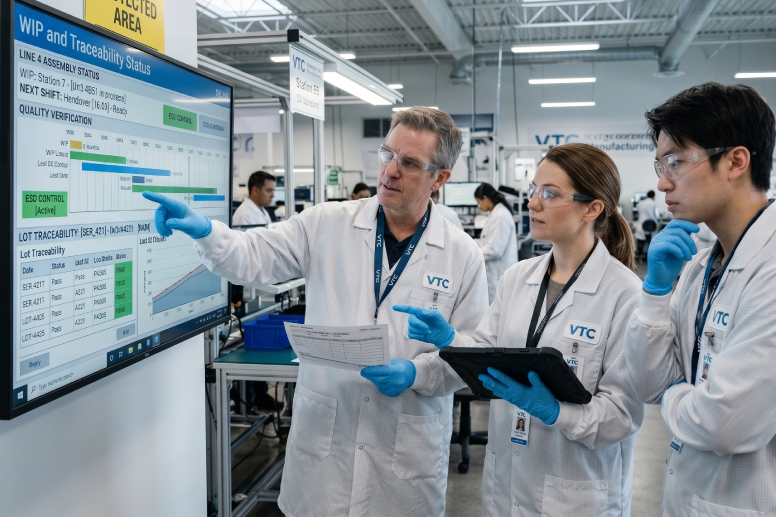
Keep the PLCs, HMIs, and proven work methods running while you digitize the record of what happened. This approach targets a direct reduction in risk to shipments and customer commitments. A layered model separates machine control, operator execution, and business reporting.
Each part can improve on its own schedule. You will typically keep machine control local, add MES for WIP tracking, and finally connect upstream systems for planning. This sequencing matters because brownfield factories carry years of local tweaks that keep yield stable.
A careful layer retains those hard-won gains while standardizing how production data is captured and reviewed. This also shifts how you staff modernization. As detailed in our Business Case guide, the financial impact surfaces quickly through fewer expedite cycles and cleaner data handoffs.
Prioritize use cases that raise throughput, quality, and on-time delivery
Prioritize modernization use cases based on measurable impacts to throughput, quality, and on-time delivery, rather than integration simplicity. Tie each use case to a specific constraint you already experience, such as a 45-minute changeover or delayed defect containment.
Start with what supervisors and quality engineers will use every day to build confidence and protect revenue. Use a short set of selection checks to keep scope tight. The goal is a release that operators accept and leadership can fund.
We recommend focusing on these practical checks for brownfield environments:
- Revenue impact is clearly linked to customer ship dates.
- Quality risk is reduced through improved genealogy tracking.
- Data exists or can be captured without intrusive machine changes.
- Operators can adopt the workflow inside normal shift routines.
- Integration effort stays bounded with a defined fallback plan.
Once priorities are clear, keep the first wave narrow. Limit the initial rollout to one product family. Process owners can validate data and adjust work instructions without constant exceptions. Expand only after you see stable usage.
Connect legacy equipment to MES using gateways, tags, and standards
Legacy equipment connects to MES successfully when you treat data capture as an engineering task with strict test criteria. Start with signals that matter for execution, like cycle start, good count, and key process parameters.
Use edge gateways and tag mapping to avoid rewriting underlying machine logic. The scope stays manageable when you define exactly what the MES needs and what the machine can reliably provide. A practical pattern on older equipment involves reading discrete signals and publishing time-stamped events to MES.
The machine program stays unchanged. Operators continue running the same start buttons, but they also scan work orders at the station. This enables the MES to link machine events to specific unit history without disrupting the operator's rhythm.
Safety and change control must sit beside connectivity work. Lockout and verification steps protect both people and production quality. Compliance matters because OSHA estimates lockout protocols prevent 120 fatalities and 50,000 injuries each year. A tight test plan keeps the line stable.
Assess cloud MES fit for security, latency, and plant connectivity
Assessing Cloud MES fitness requires verifying that your plant network can maintain connectivity and that security meets enterprise-grade standards. Security, latency, and identity controls must align with your specific regulatory and customer obligations.
The MES should support a clear integration path to ERP systems without requiring custom, one-off logic. Cloud adoption becomes highly practical when you treat the plant network and edge components as part of the MES design.
Teams often pair cloud MES with local gateways and store-and-forward buffering. The line keeps running even if network connectivity drops. Execution teams also need clear data residency and access controls to satisfy customer audits.
Cloud MES platforms like 42Q typically fit best when IT and OT share joint ownership for server management, user access, and patch cadence.
| Checkpoint | What you verify before rollout expands |
| Plant connectivity stability | Line teams can operate through routine network drops with buffered data. |
| Latency tolerance for execution steps | Operator scans and confirmations complete fast enough for takt time. |
| Security and access control model | User roles, audit logs, and authentication meet enterprise-grade standards. |
| Integration approach to ERP and quality | Interfaces have clear owners, version control, and test data sets. |
| Local support and operating model | OT and IT agree on monitoring, incident response, and change approvals. |
Sequence data, workflows, and user adoption to prevent production disruptions
Preventing disruption requires a phased sequence where data capture is stabilized before strict workflow enforcement begins. Start with passive visibility, add operator workflows, and then implement tighter routing controls after exceptions are fully understood.
Plan cutovers around shift patterns and product mix rather than arbitrary calendar milestones. Data comes first because it reveals where your current process deviates from instructions. Workflow follows closely behind.
Operators need a simple, repeatable path to record scrap and rework without slowing the line. An example is replacing paper logs with simple barcode scans for defect entry. Adoption happens last. People change behavior when supervisors and maintenance teams use the same digital record to solve daily problems.
Keep paper and digital systems running in parallel only long enough to validate, then retire the duplicate process to avoid confusion. Build training around shift turnover, common defects, and missing scan recovery.
Avoid integration failures in data governance, validation, and change control
Avoiding integration failures requires strict data governance, active validation routines, and tight change control. Most modernization failures stem from undocumented expertise and uncontrolled changes, not from the MES feature set.
Assign direct owners for every critical data element, including equipment tags, routing steps, and defect codes. Governance starts with definitions that remain consistent across plants and shifts. Agree on what counts as a good unit, what defines downtime, and who can edit history.
Validation requires comparing MES results to manual counts, quality records, and shipping data until variances are understood. Change control must include versioned work instructions and a rollback plan that production leaders accept.
This is where seasoned practitioner experience matters. As a division of Sanmina, 42Q operates across multiple factories and has seen that disciplined governance keeps modernization stable. Plants that do this improve consistency without gambling revenue on a full-scale simultaneous deployment.
Ready to connect your legacy equipment?
See exactly how edge connectivity works in practice. Request a demo of legacy equipment integration with 42Q to see how we enable seamless data capture without stopping production.
Key Takeaways:
- Brownfield modernization works best when digital execution gets layered onto existing operations, so you improve traceability and control without putting shipments at risk.
- Use case selection should start with throughput, quality, and on-time delivery outcomes, then narrow scope to what can be captured and adopted inside normal shift routines.
- Cloud MES and legacy integration succeed when connectivity, data governance, validation, and change control are treated as production disciplines, not IT tasks.
