
How AI Use Cases Cut Scrap and
Downtime on the Production Line
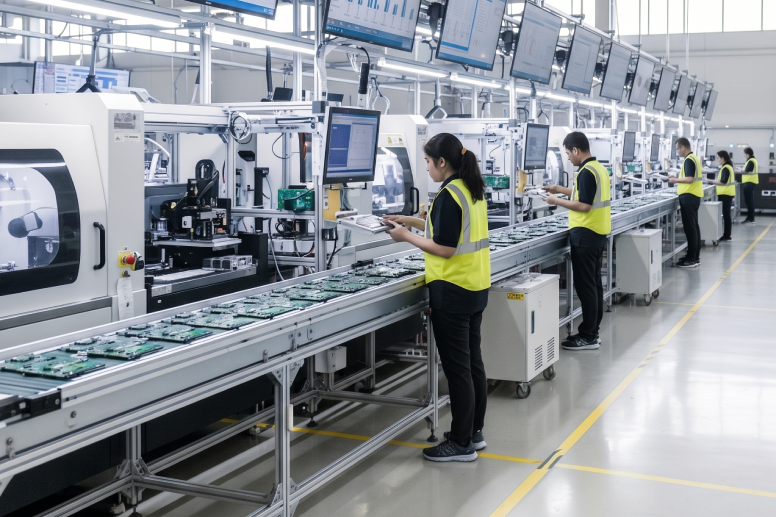
How AI Use Cases Cut Scrap and Downtime on the Production Line
In our deployment experience, manufacturers often struggle with "pilot purgatory"—testing AI in isolation without linking it to the shop floor's daily rhythm. To move beyond generic digital transformation, leadership must focus on specific applications that automate manual data entry for compliance and tighten process control.
At 42Q, we see customers significantly stabilize their lines by moving from reactive firefighting to data-driven guidance. By integrating AI into a cloud-based Manufacturing Execution System (MES), you can target the primary drivers of waste: human error during changeovers and late-stage defect detection.
Redesigning Operator Roles for the AI-Enabled Floor
Role redesign starts with one simple rule: keep responsibility clear while moving routine checks into software. This shift ensures that AI handles repeat detection while people maintain accountability.
- Operators: Shift from manual logging to confirming automated alerts and following guided digital steps.
- Technicians: Focus on condition signatures—such as vibration, temperature, and pressure—to perform maintenance before a failure occurs.
- Quality Inspectors: Pair visual intuition with model outputs to decide on "edge cases" using human-in-the-loop workflows.
- Maintenance Planners: Use trend data to schedule short, planned stops, which virtually eliminates long, unplanned outages.
7 Targeted AI Use Cases for Production Stability
1. Predictive Maintenance for Critical Assets
Predictive models forecast failure risk by monitoring signals like cycle counts and current draw. When data drifts from normal bands, the system triggers a service window.
The Result: Maintenance teams perform calibrations during scheduled pauses, protecting the mean time between failures (MTBF).
2. Computer Vision for Early Defect Flagging
Camera systems spot missing components or solder issues that the human eye might miss due to fatigue.
Specific Example: Automating visual inspection on a high-speed SMT line catches defects before the board reaches final test, reducing expensive rework loops.
3. Adaptive Process Control with Statistical Guardrails
This application adjusts parameters like feed rate or tension when sensors show drift.
- How it works: The system uses Control Charts and Capability Index ($Cpk$) values to hold the process in the "sweet spot."
- The Benefit: Stability prevents strings of scrap caused by slow environmental drift.
4. Augmented Work Guidance for Setup and Changeover
Operators scan a job barcode to receive images and short clips of the exact tooling required.
Practitioner Insight: We find that requiring step-wise confirmations ensures no part of a complex changeover is skipped, which enables a "right-first-time" setup.
5. Human-in-the-Loop Quality for Edge Cases
AI handles 95% of pass/fail decisions, but uncertain parts are routed to a human reviewer. The reviewer’s decision then "teaches" the model, improving accuracy over time without stopping the line.
6. Root Cause Analytics Across MES and ERP
True insights come from linking MES production data with ERP supplier lots.
Specific Example: A manufacturer can use Pareto charts within their analytics suite to prove that a spike in scrap at Station 4 correlates specifically to a specific raw material batch.
7. Digital Twin Tuning to Reduce Startup Waste
Engineers simulate heat profiles or clamp forces in a virtual environment before touching physical equipment. Testing these variables digitally reduces the "trial-and-error" waste typically seen during a new product ramp-up.
Essential Metrics to Prove ROI
To ensure these tools are effective, teams must monitor a specific set of KPIs. We recommend documenting these definitions once so every shift calculates them identically.
| Metric | Business Impact | Key Data Signal |
| First Pass Yield (FPY) | Reflects process stability | Pass/Fail tags per station |
| Scrap Rate (PPM) | Shows true waste in parts per million | Defect codes vs. Total units |
| Mean Time To Repair (MTTR) | Measures diagnostic efficiency | Timestamp of alert to "Fixed" |
| Prompt Adherence | Ensures workflows are followed | Operator acknowledgement logs |
Moving Toward a More Effective Production Line
Generic "Contact Us" buttons rarely help a busy Plant Manager. If you are ready to move beyond the "In today's world" style of planning and toward a practitioner-led deployment, your next step is a focused evaluation of your current data maturity.