Cloud MES Foundations for Scalable and Intelligent Manufacturing
Cloud MES Foundations for Scalable and Intelligent Manufacturing
In our deployment experience, cloud MES provides consistent execution control across plants with zero server infrastructure on-site. Manufacturing teams now expect cloud delivery for enterprise software, yet shop floors still require strict discipline around routing, quality, and traceability.
Cloud adoption is an operational norm across IT enterprise platforms. Eurostat reports that 45.2% of EU enterprises purchased cloud computing services, with adoption in advanced manufacturing sectors exceeding 70%.
Treating cloud MES as a continuous operational capability targets stable adoption and protects shop floor data integrity. This aligns directly with the financial framework in our MES Business Case guides, as speed to value relies on eliminating isolated plant hardware.
What is cloud MES and what problems it solves
Cloud MES is a cloud-delivered manufacturing execution system that standardizes, controls, and records production transactions in real time. It eliminates paper records, disconnected spreadsheets, and legacy plant systems that cause traceability gaps and unapproved process variations.
We see customers struggle when different plants manufacture the same product using inconsistent steps or logging defect codes differently. A cloud manufacturing platform closes execution gaps by enforcing mandatory data collection and controlled routings per unit.
The platform maintains single-unit genealogy, station-level transactions, routing rules, and nonconformance workflows. It supports ERP planning without replacing it, enabling reduced rework, shorter containment windows, and protected profit margins.
How cloud MES differs from on-premises MES systems
The main difference between cloud MES and on-premises MES systems is who manages the ongoing operational burden for server management, platform updates, and multi-site scaling. Cloud MES transfers platform maintenance to the cloud provider, standardizing how systems deploy across facilities.
In our deployment experience, on-premises rollouts often force teams to procure new hardware, build separate software instances, and manage independent patch cycles for every new plant. Cloud MES reduces multi-plant infrastructure overhead by providing a shared platform that enables repeatable deployment templates.
While cloud systems require reliable network connectivity, on-premises setups frequently suffer from version drift, delayed security patches, and inconsistent compliance practices across plants. Selecting the right model depends on your operational constraints rather than abstract software comparisons.
| Architectural Topic | What You Manage Most With Cloud MES | What You Manage Most With On-Premises |
| Upgrades and Patches | Focus on change control and validation windows rather than hardware maintenance. | Own manual patching, downtime scheduling, and version support. |
| Multi-plant Consistency | Reuse standardized templates to keep execution rules aligned across sites. | Manage instance drift and site-specific custom code variations. |
| Scaling New Lines | Add stations and operators without sizing new local server hardware. | Procure and configure local IT infrastructure for every capacity expansion. |
| Connectivity Planning | Design resilient edge buffering to maintain shop floor continuity. | Rely primarily on local plant network health inside the facility boundary. |
| Security Operations | Manage user roles, identity, and audit trails within a unified platform. | Manage physical server access, operating system hardening, and local backups. |
| Cost Structure | Budget for subscription services and active operational configuration work. | Budget for capital hardware purchases, internal support, and refresh cycles. |
Core capabilities to require in cloud manufacturing software
Core capabilities required in cloud manufacturing software include controlled routing, unit-level serialization, closed-loop defect logging, electronic work instructions, and multi-site reporting. Without these foundational controls, a system provides reporting dashboards without real execution enforcement.
We see operations encounter friction when quality checks are corrected after the fact rather than enforced during transaction time. Controlled routing prevents process drift from becoming scrap by enforcing mandatory signoffs at execution time.
Key capabilities to mandate during evaluation include:
- Controlled Routing: Enforces correct operation sequencing and captures required digital signoffs before a unit advances.
- Unit-level Serialization: Links component lot numbers, process steps, and test parameters to individual product history.
- Closed-loop Defect Logging: Captures nonconformances and forces structured repair workflows before product release.
- Electronic Work Instructions: Delivers version-controlled visual assembly guidance directly to workstation screens.
- Multi-site Reporting: Compares global line performance using standardized data schemas and identical time metrics.
Data, integration, and latency considerations for shop floor control
Shop floor control depends on sub-second transaction timing, resilient edge buffering, and clean system ownership boundaries. In our deployment experience, cloud MES functions best when production events serve as the real-time source of truth for plant activity.
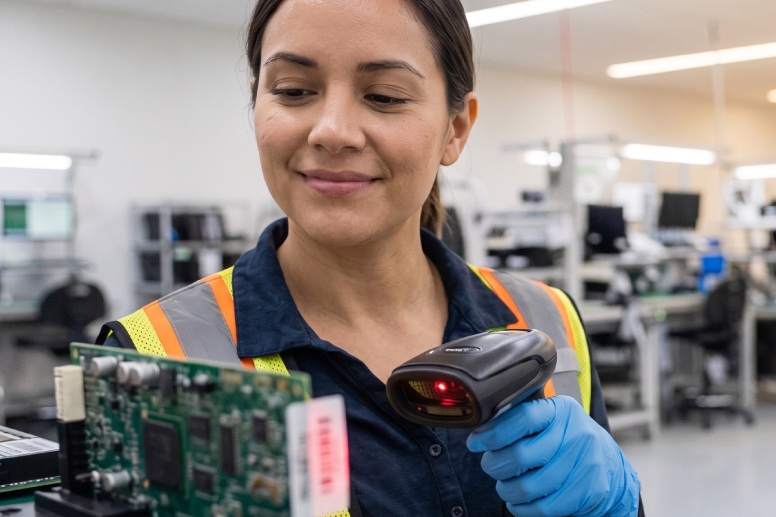
Consider a packaging line scanning serialized barcodes at final inspection to validate work orders, routing steps, and label compliance prior to shipment. If every scan waits on round-trip network calls to external databases, line stalls occur and operators resort to undocumented workarounds.
Edge buffering allows local stations to process scans immediately while synchronizing supporting data asynchronously to prevent line stalls.
Keep enterprise integrations tightly focused. The ERP system supplies work orders, bill of materials revisions, and inventory contexts, while the MES manages step-by-step execution and component genealogy.
Hardware integrations should start with critical quality signals before expanding to secondary telemetry. Clean master data governance prevents broken reports even when interface calls succeed. This integration architecture reflects our guidelines for Connected Manufacturing.
Security, compliance, and residency needs for regulated manufacturers
Regulated manufacturing requires enterprise-grade security controls that verify user identity, maintain immutable audit trails, and enforce data residency policies. Security audits fail more frequently from human process gaps than from cloud infrastructure vulnerabilities.
Industry research indicates that 68% of breaches involve a human element, such as shared user accounts or overbroad permissions. Role-based access controls support FDA and ISO compliance by restricting operator permissions strictly to active station tasks.
Cloud MES platforms support regulatory compliance controls (such as FDA 21 CFR Part 11 and ISO 13485 requirements) by managing system access and logging event history. Operators should access only the specific screens required for their shift, while engineering updates follow formal digital approval paths.
Verify encryption standards, key management protocols, and data residency options prior to system launch.
Implementation steps to scale from pilot to multi-plant rollout
Scaling cloud MES requires validating a repeatable operational template on a single pilot line before replicating the standard across additional facilities. A pilot deployment should validate core routing rules, operator data capture, and critical system integrations on a defined product family.
In our multi-site deployments, scaling fails when plant governance is treated as optional. Using a successful pilot line as an enterprise reference model enables rapid multi-plant scaling with controlled local variation.
Replicating an established template avoids full-scale simultaneous deployments that overwhelm project resources. Platforms like 42Q enable teams to establish a baseline configuration on line one and deploy it across additional lines and plants with standardized master data.
Training should focus specifically on handling process exceptions to prevent teams from returning to paper records.
Common failure modes when moving MES to the cloud
Most cloud MES failure modes originate from unaddressed shop floor process variation, messy master data, and weak integration boundaries rather than cloud technology limitations. Moving messy legacy processes to the cloud accelerates the visibility of operational gaps without fixing the underlying execution habits.
We see teams struggle when attempting to write custom software logic to match every unapproved shift habit. Treating cloud MES as an operating system model with strict data governance eliminates silent release risks and reporting arguments.
Avoid common deployment traps by establishing clear data ownership across systems:
- Over-customization: Writing custom software code to mimic legacy habits creates brittle installations that stall future updates.
- Vague Data Boundaries: Allowing ERP, MES, and local controllers to claim ownership of the same data fields causes reporting disputes.
- Permissive Role Design: Granting broad system access during launch erodes audit readiness and increases bad release risks.
- Neglected Network Planning: Failing to plan for edge buffering causes latency stalls that encourage operators to bypass the system.
Sustained manufacturing value comes from pairing cloud software with disciplined process ownership and master data control. Enterprise platforms like 42Q provide the architecture and templates necessary to support consistent, scalable execution across global factories.
Ready to evaluate cloud MES for your manufacturing footprint?
Request our Cloud MES Architecture & Compliance Audit Checklist to evaluate your multi-plant readiness and schedule a demo to see how 42Q controls execution across global plants.
Key Takeaways
- Standardize the Operating Model: Cloud MES scales only when you standardize execution rules, master data ownership, and plant-to-plant governance before expanding to new sites.
- Enforce Core Shop Floor Controls: True production value comes from strict route enforcement, unit-level genealogy, closed-loop defect logging, and controlled work instructions with sub-second transaction timing.
- Design for Compliance Early: Security controls, role-based access, audit trails, and data residency must be treated as core production requirements from day one of deployment.