Building MES Capability Through Operator Focused Training
Building MES Building MES Capability Through Operator-Focused Training
Operator-focused MES training targets specific production workflows to drive reliable data collection. In our deployment experience, MES rollouts fail most often at the operator screen rather than in the server room because every missing scan, skipped check, or wrong code becomes permanent production history.
Skills gaps are widening fast enough that informal shadowing will not keep up. The share of workers whose core skills will change in the next few years is projected at 39%. That data point transforms training design into a critical manufacturing control rather than a standard HR activity.
Treating MES training as a continuous capability you build, rather than a one-time class, targets stable adoption and protects data integrity. When training maps to exact shop floor transactions, adoption rises. This connects directly to the ROI discussed in our MES Business Case guides, as downstream analytics and compliance rely entirely on clean operator input.
Define operator tasks and MES transactions that matter most Operator training delivers value when it explicitly targets the few MES actions that control throughput, quality, and traceability. Start with the tasks operators perform per unit and per shift. Then, map each task to the exact MES transaction and required data fields.
Treat every field as a business rule instead of a simple screen prompt to drive better data quality. We see customers struggle with this when they do not consult the shop floor team. Good scoping begins with the people who build the product because they know exactly where work actually pauses or where rework starts.
Ask two questions for each transaction to find what matters most. What happens if it is skipped? What happens if it is wrong? Transactions that create serialized genealogy, apply routing controls, and record defects typically rise to the top of the priority list.
This approach enables you to train the right behaviors. If the MES requires a reason code, define what a valid entry looks like. Operators need to know when they should stop and ask for help to prevent informal workarounds under time pressure.
Build a role-based MES training strategy and learning paths A working MES training strategy separates roles because operators, line leads, technicians, and supervisors use different workflows. Build training paths that match what each role must do on day one. Then, add skills for exceptions and escalation as they grow in their positions.
Tie completion to demonstrated ability rather than attendance so readiness has a clear, measurable meaning. Role design prevents a common failure mode we see frequently on the floor. Overtraining new operators on features they will never touch slows learning and increases mistakes.
Keep the initial path narrow and job-focused. You can expand it after stability is achieved. This step is also where you decide how much to standardize across plants, as the same role can vary if routing or quality gates differ between facilities.
To ensure role-based training is effective, we recommend building paths around these core checkpoints:
- List each role and the exact MES permissions it needs.
- Define day-one tasks that cannot be skipped.
- Document the top exceptions that cause downtime or scrap.
- Set a clear escalation path for data or routing questions.
- Require a hands-on checkoff before independent system use.
Design training that fits shift work and shop floor constraints MES user training must fit short, repeatable sessions that respect shift reality and operator fatigue. It cannot depend on perfect attendance or long classroom blocks. On the plant floor, manufacturers who incorporate alternative work schedules report flexible options increase satisfaction for up to 67% of workers, aiding in turnover reduction and employee retention.
Short training sessions work best when each has a single outcome, a quick demonstration, and immediate practice. You also need a plan for language, literacy, and device familiarity. Do not turn the program into a generic computer class.
If the MES runs on shared terminals, set strict rules for logins and badge use. Training should not teach bad habits that cause traceability gaps. Training design also needs operational protections to avoid disrupting the floor.
If operators practice in production, mistakes can become scrap or bad history. If they practice off-line, the experience can feel fake unless the prompts match reality. Pick one approach per site and make it predictable for supervisors.
Use guided practice, sandboxes, and error recovery for confidence Operators learn MES fastest through guided practice that mirrors their actual sequence of work. They need a safe space to recover from common errors without impacting live production. A sandbox instance is useful only when it reflects live configuration and master data.
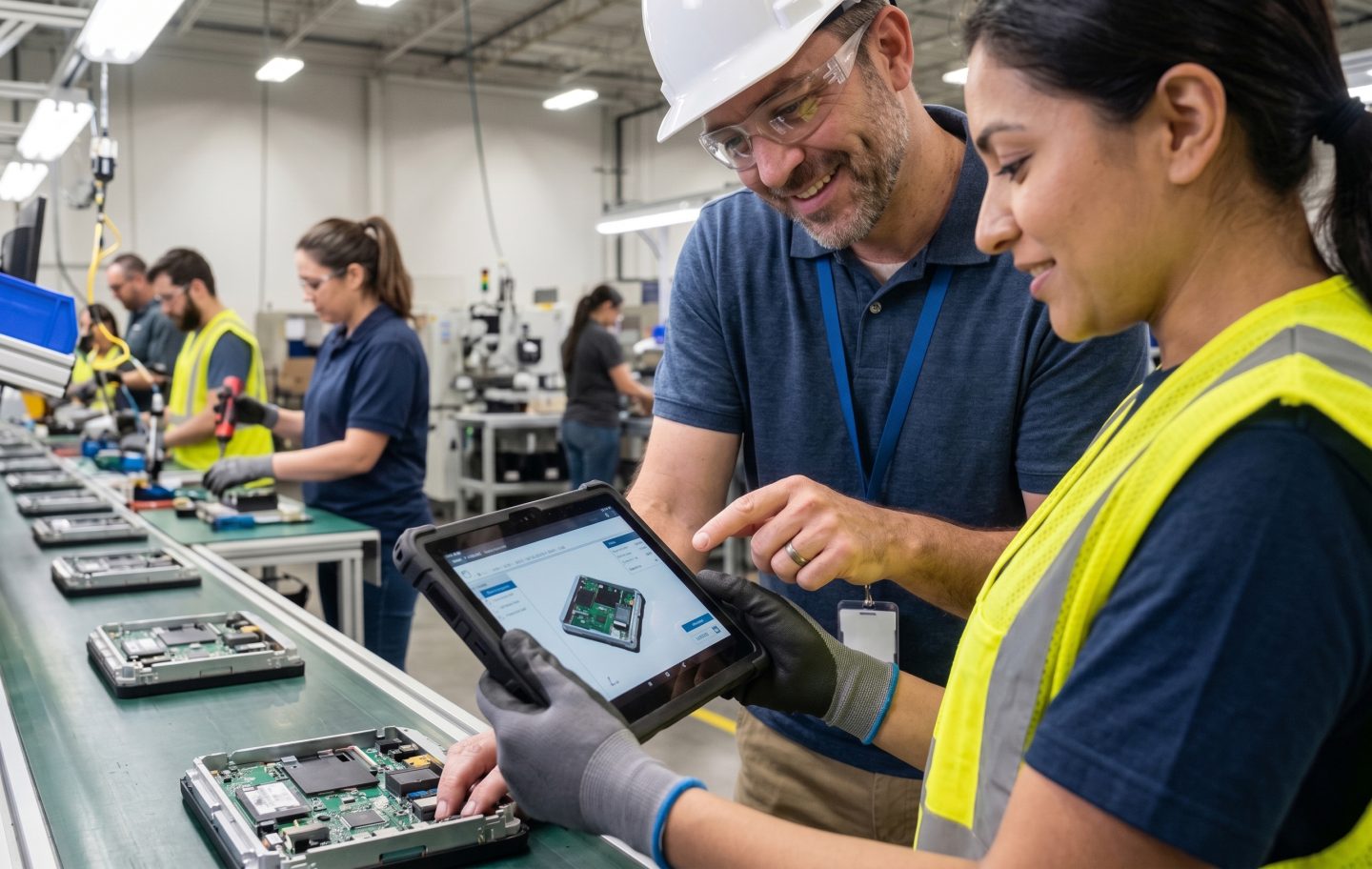
Build practice around the exceptions that cause the most confusion because confidence comes from knowing how to correct mistakes. A concrete scenario makes this point clear. A new operator assembling a serialized device can practice starting an operation.
They can scan a component lot and then intentionally scan the wrong lot. This lets them see the system block the step and prompt for the correct action. The practice should also cover what to do when a barcode fails to scan or a station goes down.
Those specific moments are when informal workarounds usually start. Guided practice sets standards for speed and accuracy without shaming learners. Time-box the practice so operators build a steady rhythm before adding complexity.
In our deployments using a cloud MES solution, teams often create a training tenant mirroring production configuration. This enables realistic practice while protecting live data integrity.
Reinforce with supervisors, work instructions, and daily coaching loops Training sticks when supervisors reinforce the exact same system behaviors every single day. They must use the same language and the same work instructions. Operators watch what leaders tolerate during peak production hours.
Coaching must happen during normal production runs rather than just during launch week. Keep work instructions tightly aligned to the MES screens operators actually see. Otherwise, people will follow the paper and ignore the system entirely.
Supervisors also need their own preparation. They decide what happens when the line falls behind schedule. If the standard is to scan every unit, a missed scan is a quality event and should not be treated as a clerical issue.
Coaching loops work best when they are short and highly specific. Observe one transaction, confirm the reason behind it, and correct it immediately. Reinforcement must include an escalation habit that feels safe for the team so they do not hide system issues.
Measure proficiency, data quality, and performance after go-live Go-live success depends entirely on what you measure after the system launches. Adoption problems show up first as messy data and uneven transaction timing. Track operator proficiency through checkoffs and targeted shop floor observation.
Treat system signals like missing scans, late completions, and excessive overrides as process controls that trigger coaching. Measurement keeps your training program from turning into undocumented institutional memory. If one shift has more defects recorded but fewer rework closures, investigate the workflow.
That pattern points to a workflow misunderstanding, a permission issue, or a supervision gap. If routing violations spike at one station, the fix might be a better instruction, a clearer prompt, or tighter master data. Each pattern should map to a specific intervention.
The team learns that metrics trigger support and correction instead of punishment. Operator training is often the primary limiter on MES value realization. Disciplined execution will beat full-scale simultaneous deployments every time.
Teams that treat training as an operating system will target stable adoption that lasts. This approach reflects how 42Q teams typically run multi-plant MES programs under production pressure.
Ready to build a shop-floor training plan that sticks? Request a demo to see how 42Q enables safe, guided practice in a cloud sandbox environment.
Key Takeaways
- Target Critical Workflows: Scope operator training to the specific MES transactions that control traceability, quality, and flow. Teach the business rule behind each required field to ensure clean data input.
- Prove Readiness Over Seat Time: Build role-based learning paths designed around shift realities. Use hands-on checkoffs that prove true capability rather than tracking hours spent in a classroom.
- Sustain Data Integrity: Protect shop floor data after go-live through sandbox practice, daily supervisor coaching loops, and post-launch metrics that trigger targeted retraining instead of punishment.